


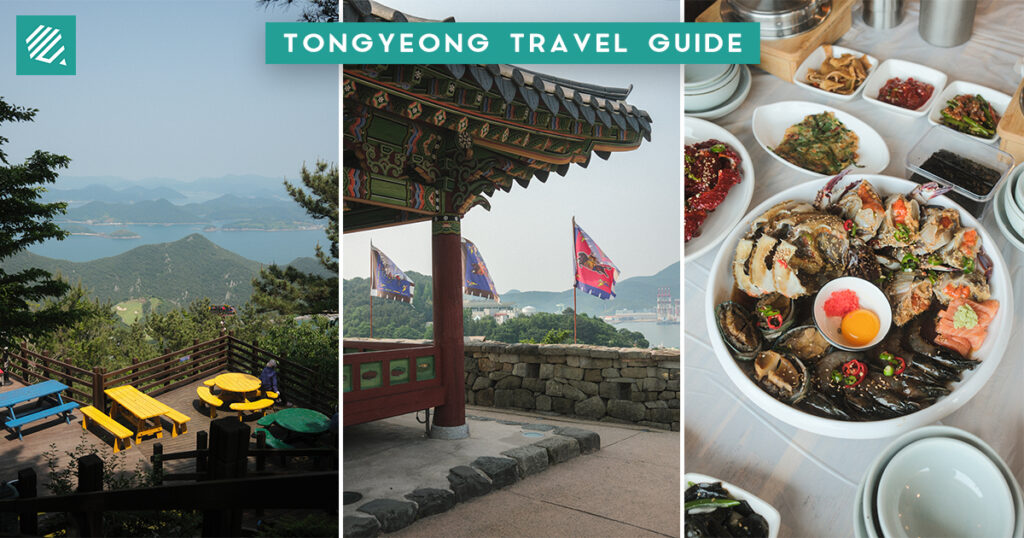
Tongyeong is a coastal city in South Korea’s South Gyeongsang Province that surprises, feeds, and quietly rewires your idea of a Korean getaway. It’s not Seoul’s neon grid. It’s not Busan’s loud beach energy. It’s a place where a 400-year-old fish market operates next to a digital art immersion space, where a village that was nearly demolished became one of the most photographed mural streets in the country, and where the local oysters are so good that they’ve given rise to their own soup and their own festival.
Not just another seaside town. Tongyeong is what you visit when you’ve done Korea’s obvious hits and want the version that actually lives here.
Table of Contents
Where Is Tongyeong?
Tongyeong (통영) is a port city on the southern coast of South Korea, in South Gyeongsang Province, sitting where the Korean peninsula meets the Korea Strait. It’s often called the “Naples of Korea”, a nickname earned from the way the city spills down hillsides toward the sea, surrounded by 530 scattered islands. The old name was Chungmu, and if you’ve eaten Chungmu gimbap at a Korean restaurant, you’ve already tasted this city without knowing it.
What separates Tongyeong from other Korean coastal destinations isn’t any single landmark. It’s the density of good things packed into a small, walkable area. The cable car, the mural village, the digital art park, the centuries-old market, and some of the freshest oysters in Asia all sit within a few kilometres of each other. Three days here feels like a week somewhere else, in the best possible way.
Why Visit Tongyeong?

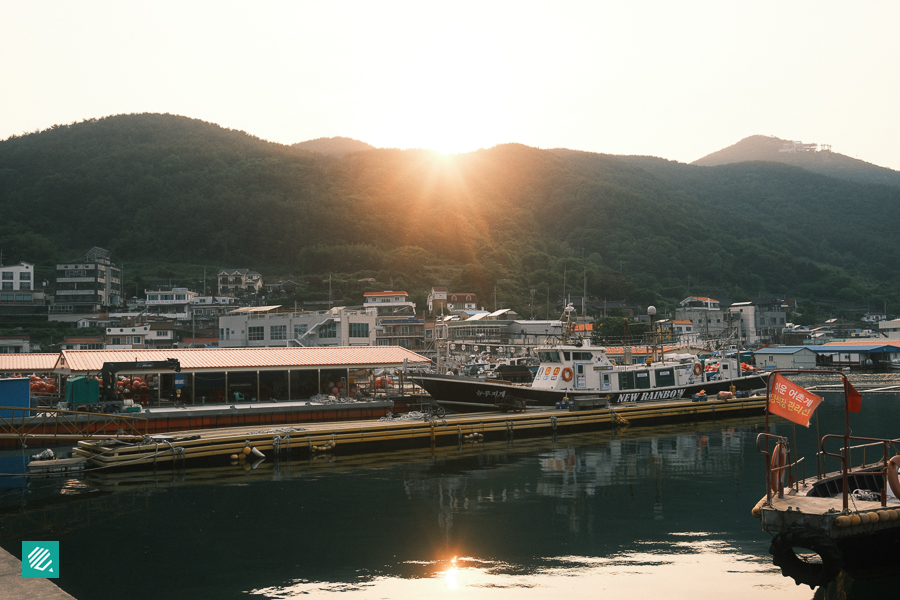
Most Singapore travellers to Korea route through Seoul, Busan, or Jeju. Tongyeong doesn’t make the shortlist. That’s both the problem and the opportunity.
The city punches well above its size. It produced Korea’s most celebrated classical composer, Isang Yun. It was the base of Admiral Yi Sun-sin, whose naval battles against the Japanese fleet in the 1590s are still studied in military academies worldwide. Its oyster farms supply restaurants across the country. And its cable car, at 1,975 metres, held the record as Korea’s longest tourist ropeway for years.
You’re also arriving without the crowds that swamp better-known destinations. Dongpirang Village on a Tuesday morning feels nothing like Bukchon Hanok Village on a Saturday afternoon. The fish market stallholders have time to talk. The cable car gondola might be just yours.
That’s a rarer thing than it sounds.
Ride the Tongyeong Cable Car
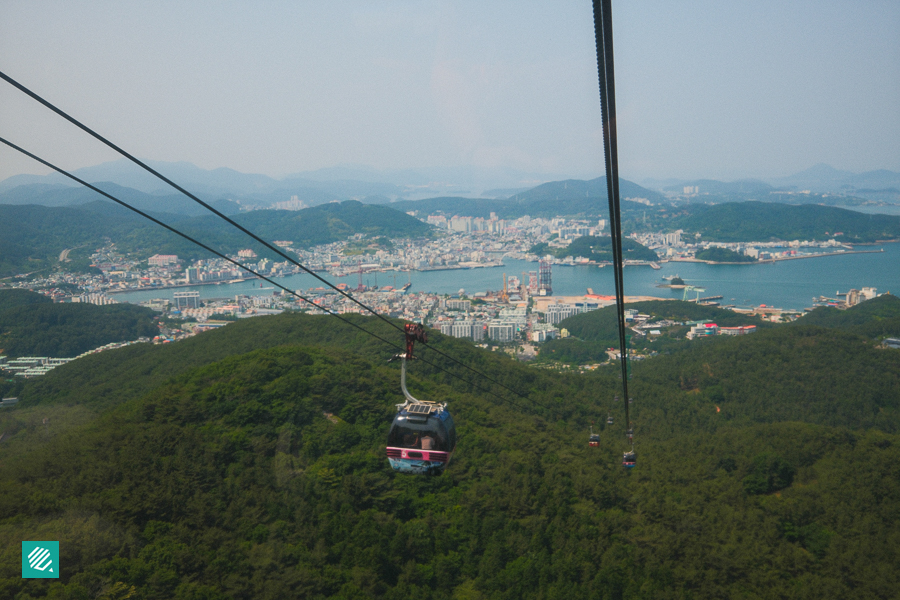
The Tongyeong Cable Car runs 1,975 metres from the lower station to the summit of Mireuksan Mountain at 461 metres above sea level. At the top, the observation deck looks out over Hallyeohaesang National Park, a protected marine zone that covers 530 islands and islets along the south coast. On a clear day, you can see the outline of Japan’s Tsushima Island on the horizon, roughly 80 kilometres offshore.
A glass-floored skywalk extends from the summit platform for visitors who want to feel the mountain underneath their feet, minus the mountain. Take it. The vertigo is part of the experience.
Practical info: The cable car operates year-round. Tickets are around ₩15,000 for adults (round trip). Combo packages with DPIRANG and the nearby Luge track offer discounts. The lower station is about 15 minutes by taxi from Gangguan Port.
Explore DPIRANG
DPIRANG is a digital art immersion park that opened in the hills above Tongyeong, built on the concept of bringing the city’s lost murals back to life through light and media technology. The name merges “Dong-pirang” (the eastern cliff) and “Seo-pirang” (the western cliff), the two mural villages whose painted walls have faded or been painted over through the years. DPIRANG recreates them and then exceeds them.
The space runs across 15 interactive zones, each with a different atmosphere. “Lightfall” fills a room with cascading light particles. “Painted Sea” projects the coastline across every surface until you feel you’re standing inside a watercolour. “The Forgotten Door” leads into a passageway where old murals glow and shift on the walls like living photographs. It’s not a museum in any traditional sense. It’s closer to walking through someone’s memory of a place.
For travellers doing both DPIRANG and the cable car in the same day, combined ticket packages cut the total cost by around 20%. Buy them at either venue or through Trazy before you arrive.
The experience runs about 60 to 90 minutes depending on how long you linger. Bring your phone, the light installations are built to be photographed, and every room delivers a different shot.
Wander Through Dongpirang Village’s Murals
In 2007, the Tongyeong city government announced plans to demolish Dongpirang, a working-class hillside neighbourhood overlooking the harbour, to make way for a marina development. A grassroots campaign by the Tongyeong Agenda 21 association responded with an unusual counter-proposal: paint the walls.
They invited university art students and community artists from across Korea to fill every available surface: walls, fences, stairs, chimneys, and water tanks with murals. The resulting installation attracted so much public attention that city planners abandoned the demolition plan entirely. Dongpirang survived. Then it thrived.
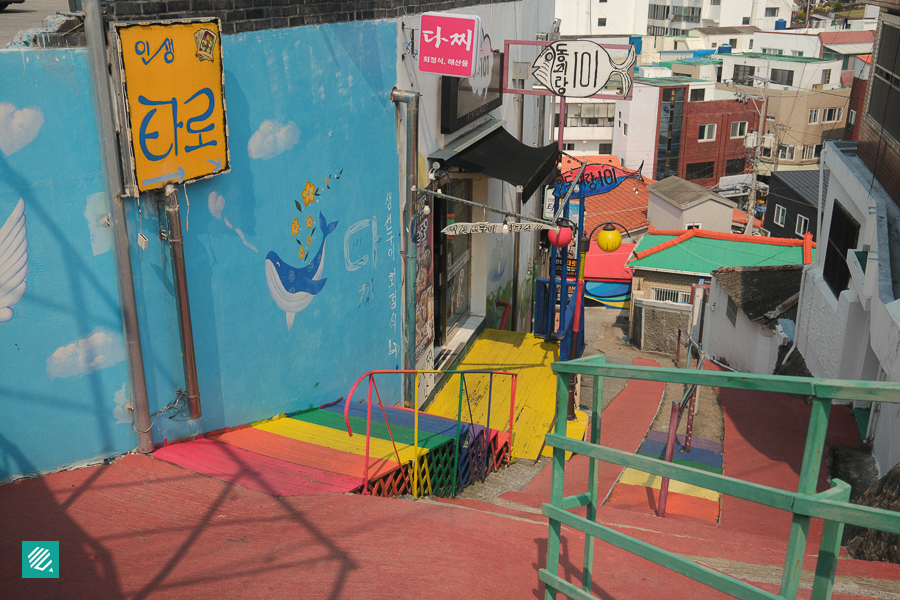
Today, the village is one of the most visited attractions in Gyeongsangnam-do province. The name translates roughly to “eastern cliff” in the local dialect, and the climb earns its views. Narrow lanes wind between single-storey homes painted in deep blues, burnt oranges, and soft yellows. Murals range from folk art animals to abstract geometric shapes to portraits of local fishermen. Cats lounge in the alleyways as if they own the place. (They mostly do.)
The walk from the entrance at Jungang Market to the top of the hill takes around 20 to 30 minutes at a gentle pace. There’s no entrance fee. The best time to visit is early morning before tour groups arrive, or late afternoon when the golden-hour light hits the painted walls.
One thing worth knowing: Dongpirang’s murals are repainted every few years by new artists, so the village looks different on each visit. What you photograph today may not exist in the same form in two years. That’s either a reason to hurry or a reason to come back.
Eat Your Way Through Tongyeong Jungang Market
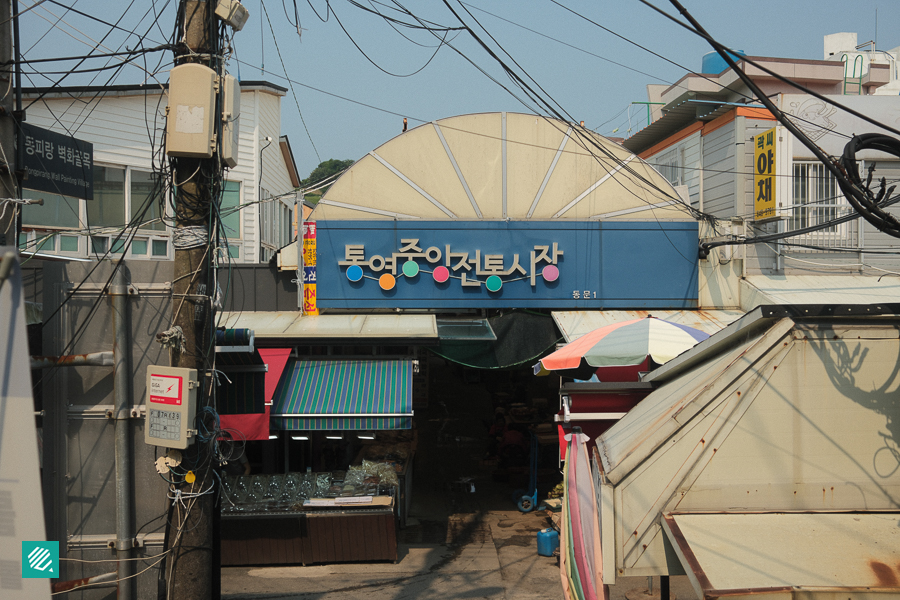
The smell hits before you see it. Salt and sea air and something frying somewhere, and then you’re inside Tongyeong Jungang Market and every stall is shouting for your attention in the best possible way.
Jungang Market (통영 중앙시장) has operated in some form for nearly 400 years, the bones of the place are old, but the produce is aggressively fresh. Located just below Dongpirang Village near Gangguan Port, it operates daily with most stalls running from mid-morning through early evening.
The front section is a seafood parade: live squid in tanks, whole dried anchovies by the kilo, trays of shucked oysters glistening in the light, sea cucumbers, abalone, and species you won’t recognise, but someone will happily name for you.
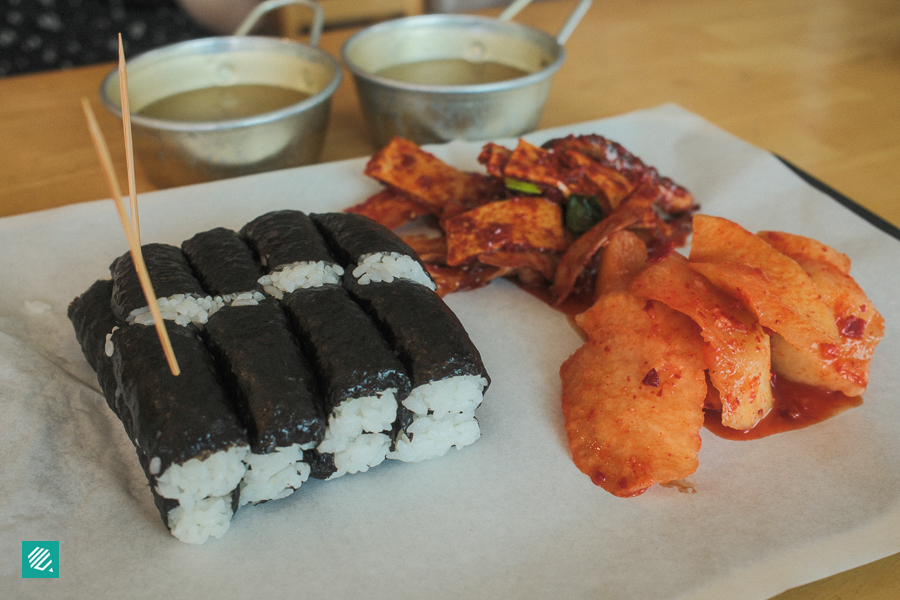
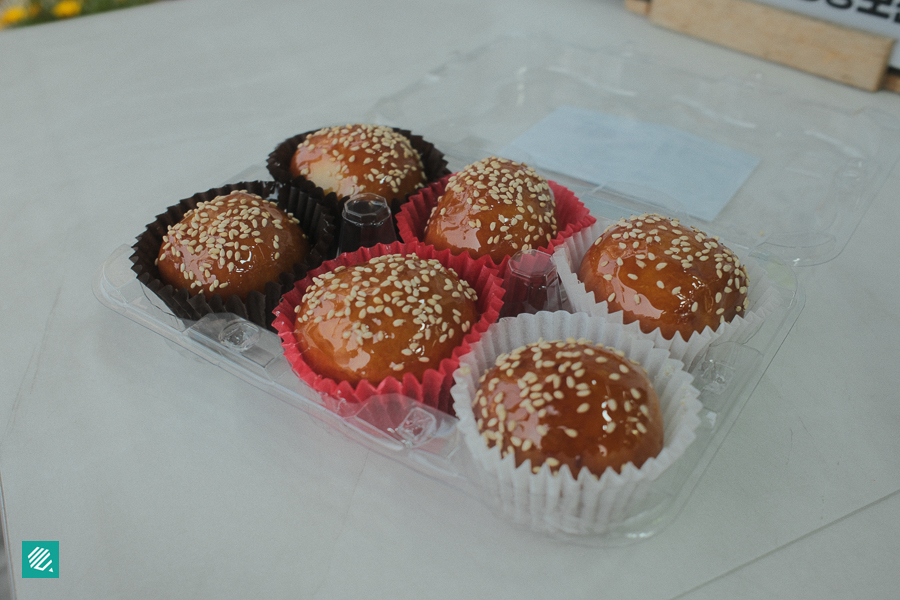
Further in, you’ll find the cooked food section. Highlights include:
- Honey bread (꿀빵): Tongyeong’s most famous market snack: a deep-fried dough ball filled with red bean paste and glazed with honey syrup. Vendors near the market entrance sell them freshest.
- Chungmu gimbap: The original. Unlike Seoul-style gimbap, Tongyeong’s version uses plain unseasoned rice with no fillings, served alongside radish kimchi and spicy squid. The contrast is the point.
- Fresh sashimi: Buy from a front stall, take it to the preparation area at the back with a few side dishes, and eat it on the spot. Around ₩15,000 to ₩30,000 depending on what you choose.
The market is busiest on weekends but worth visiting on a weekday if you prefer to browse without being swept along. Budget two hours.
Try Tongyeong’s Famous Oyster Rice Soup (Gulbap)
If there’s one dish you eat in Tongyeong, it’s gulbap (굴밥).
The waters around Tongyeong are cold in summer and warm in winter, the opposite of most coastal climates which creates ideal conditions for plankton growth. Plankton is what oysters eat, and Tongyeong’s oysters eat extremely well. The city produces a significant share of South Korea’s total oyster harvest, and you can taste the difference. These aren’t the flat, briny oysters you get on ice at a European seafood bar. They’re plump, sweet, clean, and deeply oceanic.
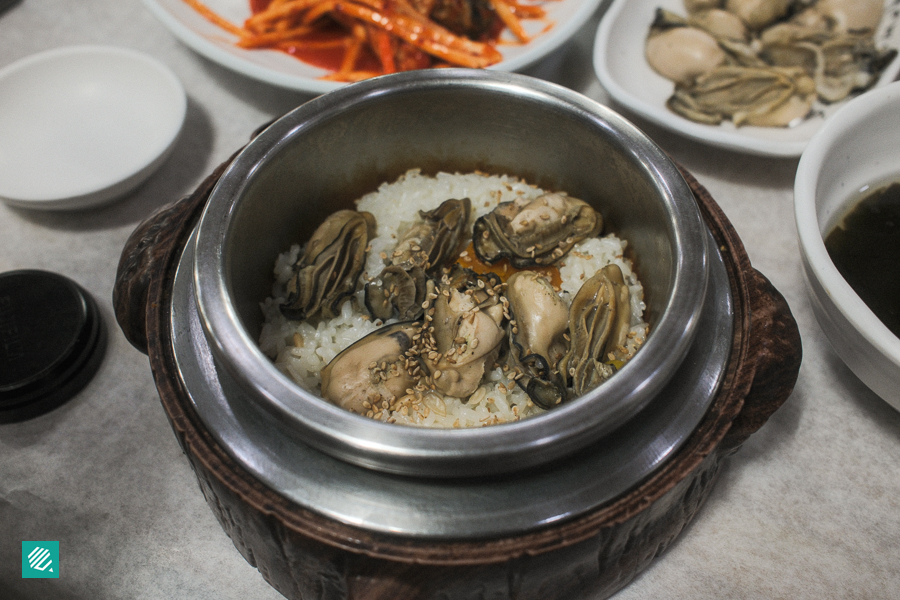
The dish is built on well-washed short-grain rice laid with chestnuts, ginkgo nuts, jujube, sweet pumpkin, and walnuts, then topped with raw oysters and steamed together until the oysters cook through and their juice soaks into every grain. The result is a bowl of rice that tastes like the sea came inland.
Many restaurants serve it with a clear oyster broth on the side (gulgukbap style), a small bowl of doenjang jjigae, and three or four kimchi side dishes. A full meal costs ₩12,000 to ₩18,000. Don’t let the price fool you about the quality.
If you need recommendations, we tried Gulbap at this spot called Hanmaeum Sikdang (한마음식당).
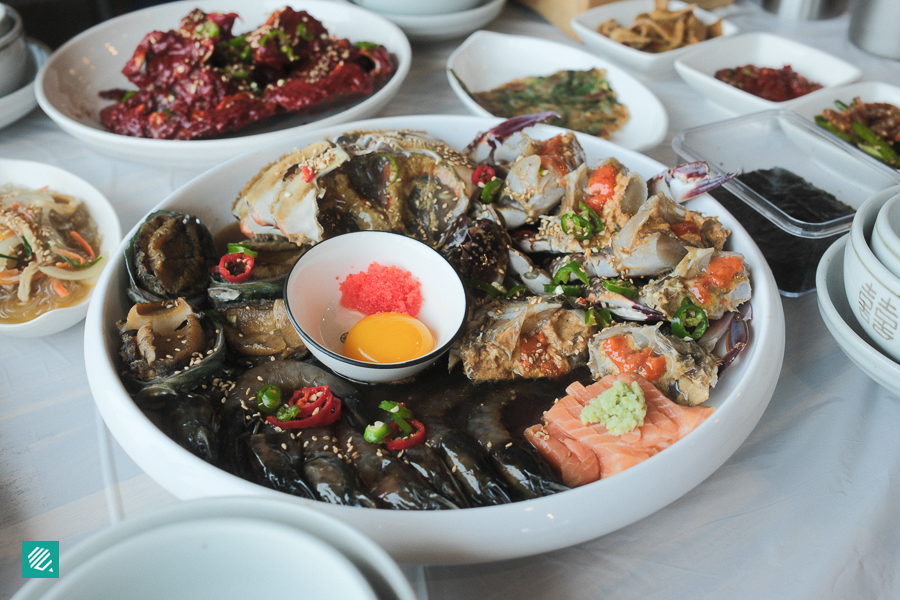
If oysters aren’t your thing, other seafood options in Tongyeong include raw marinated crab, and trust us when we say this city is the best place to try Ganjang Gejang. You’re getting so much more in value, especially when prices are cheaper compared to Seoul.
How to Get to Tongyeong from Singapore
Tongyeong doesn’t have its own airport. Getting there requires one connection which sounds like extra effort until you factor in how little time it actually takes.
Via Busan (recommended for most Singapore travellers): Singapore Airlines, Scoot, and Jetstar fly direct from Changi to Gimhae International Airport (Busan) in approximately 5.5 hours. From Busan, intercity buses depart from Busan Seobu (West) Bus Terminal: accessible from Sasang Station on Busan Metro Line 2 (every 20 to 30 minutes).
The journey to Tongyeong Bus Terminal takes 1 hour 30 minutes to 1 hour 50 minutes. Tickets cost ₩11,000 to ₩13,000 one way.
Via Seoul: If you’re flying into Incheon, express buses from Seoul’s Gyeongbu Express Bus Terminal to Tongyeong run roughly every hour between 7am and 11pm. The journey takes about 4 hours 10 minutes. Fares range from ₩38,600 to ₩50,200 depending on bus type.
Tongyeong from within Korea: The city makes an easy add-on to a Busan or Gyeongsang Province trip. Many travellers route Seoul → Gyeongju → Busan → Tongyeong over 7 to 10 days.
When Is the Best Time to Visit Tongyeong?
Spring (April to May) is the most popular window, and deservedly so. Cherry blossoms frame the harbour views from Dongpirang, the weather runs 15°C to 22°C, and the tourist crowds haven’t hit peak summer levels yet.
Autumn (September to November) is the local favourite. The foliage on Mireuksan turns, the air sharpens, and oyster season hits its stride. October in Tongyeong is genuinely excellent.
Summer (June to August) brings warmth and festival energy but also heavy rainfall during the monsoon weeks in July. Humidity is high. If you’re visiting in summer, build in flexibility.
Winter (December to February) is low season and rewarding for the right traveller. Crowds are minimal, the cable car views on a clear winter day are extraordinary, and oysters are at peak plumpness. Just bring a proper jacket.
Where to Stay in Tongyeong
First-time visitors should base themselves near Gangguan Port. From here, Dongpirang Village, Jungang Market, the ferry terminals, and the city’s waterfront restaurants are all within easy walking distance.
Budget options (₩40,000 to ₩60,000 per night) are mostly motels near the bus terminal or on the Gangguan waterfront. Mid-range hotels and guesthouses (₩80,000 to ₩130,000) often offer sea-view rooms worth paying for. A few pensions on the hillsides above the harbour have the best morning views in the city.
Challenges and Limitations of Visiting Tongyeong
Getting around without Korean: Most restaurant menus and market stalls don’t have English translations. Google Translate’s camera function handles this reasonably well. Point it at a menu, and you’ll get the gist. Naver Map (not Google Maps) is far more accurate for navigation within Korean cities.
Transport from Tongyeong: The city is not on any train line. Everything in and out goes by bus. This isn’t a problem but it’s worth knowing before you schedule a tight connection.
Day trip limitations: Tongyeong is sometimes marketed as a day trip from Busan. Technically possible; experientially a waste. The cable car, DPIRANG, Dongpirang, the market, and a proper gulbap meal take the better part of two days. Book at least one night.
Peak season accommodation: Tongyeong’s accommodation inventory is limited relative to demand during golden weeks (Chuseok, Children’s Day in May, National Foundation Day in October). Book at least three weeks ahead during these periods.
The cable car closes in bad weather: Wind above a certain threshold shuts the gondolas down. If you’re visiting in autumn or winter, check the forecast and have a backup plan.
Frequently Asked Questions about Tongyeong
What is Tongyeong known for?
Tongyeong is known for its fresh oysters, dramatic coastal scenery, and the Hallyeohaesang National Marine Park surrounding it. The city also has significant historical importance as the base of Admiral Yi Sun-sin, and cultural prominence through classical composer Isang Yun. In food terms, Tongyeong is the origin of both Chungmu gimbap and gulbap (oyster rice).
How far is Tongyeong from Busan?
Tongyeong is approximately 100 kilometres southwest of Busan. By intercity bus from Busan Seobu Bus Terminal, the journey takes 1 hour 30 to 1 hour 50 minutes. It’s a straightforward add-on to any Busan trip.
How long should I spend in Tongyeong?
Two nights and two full days is the sweet spot for first-time visitors. That’s enough time to ride the cable car, walk Dongpirang, spend a morning at the market, visit DPIRANG, and eat properly. One night feels rushed. Three nights suits slower travellers or those island-hopping to nearby Bijindo or Yeonhwado.
What is gulbap?
Gulbap (굴밥) is Tongyeong’s signature dish: steamed rice cooked with fresh oysters, chestnuts, ginkgo nuts, jujube, and sweet pumpkin. It’s served with oyster broth and side dishes. The dish showcases Tongyeong’s oysters, which are considered some of the best in Korea due to the region’s ideal plankton-rich waters.
Is the Tongyeong Cable Car worth it?
Yes. The cable car ride to the summit of Mireuksan Mountain (461 metres) delivers one of the most expansive coastal views in Korea. The ride costs around ₩15,000 for adults (round trip) and takes 9 minutes each way. Combo tickets with DPIRANG offer around 20% savings.
What is DPIRANG?
DPIRANG is a digital art immersion park in Tongyeong that uses light and projection technology to recreate the city’s historic mural villages in interactive, walkable installations. It spans 15 themed zones and takes 60 to 90 minutes to experience. It’s different from the actual Dongpirang Mural Village, which is free to enter and a short walk away.
Is Dongpirang Village free to enter?
Yes. Dongpirang Village has no entrance fee. The walk from the entrance near Jungang Market to the hilltop takes 20 to 30 minutes. The murals are repainted periodically, so the village looks different on each visit.
What is the best food to eat at Tongyeong Jungang Market?
Honey bread (꿀빵), Chungmu gimbap, and fresh sashimi are the three must-tries. The honey bread is a deep-fried dough filled with red bean paste and glazed with honey and is a Tongyeong market original. Chungmu gimbap, served with spicy squid and radish kimchi, is the city’s most famous street food export.
Can I visit Tongyeong as a day trip from Busan?
Technically yes, but it’s not recommended. Getting there takes 1.5 to 2 hours each way, leaving roughly 5 to 6 hours on the ground. That’s enough for Dongpirang and the market, but not enough to do the cable car, DPIRANG, and a proper meal. At least one night makes the trip feel complete.
What is the best time of year to visit Tongyeong?
Spring (April to May) and autumn (September to November) are ideal. Spring brings mild weather and cherry blossoms; autumn brings the best oyster season and foliage on Mireuksan. Winter is quiet and uncrowded, with oysters at peak quality. Summer is liveable but monsoon rain can disrupt plans.
How do I get to Tongyeong from Seoul?
Express buses from Seoul’s Gyeongbu Express Bus Terminal run to Tongyeong Bus Terminal roughly every hour between 7am and 11pm. The journey takes about 4 hours 10 minutes. Premium bus fares range from ₩38,600 to ₩50,200 depending on bus type.
Does Tongyeong have an airport?
No. The closest airports are Gimhae International Airport (Busan, about 1.5 hours by bus) and Sacheon Airport (about 40 minutes, with limited domestic routes). Most international visitors fly into Busan or Seoul and travel onward by bus.
Related Reading
- Geoje Island: South Korea’s Undiscovered Coastal Paradise
- Ulsan One-Day Itinerary
- Our Guide to Gyeongju in Spring


This post was done in partnership with Korea Tourism Organization (Singapore).